The Ultimate Guide to Building a Professional Website in 2026 (Step-by-Step + Cost Breakdown)
A complete step-by-step guide to building a professional website in 2026, including cost breakdown, essential elements, and key mistakes to avoid for maximum results.
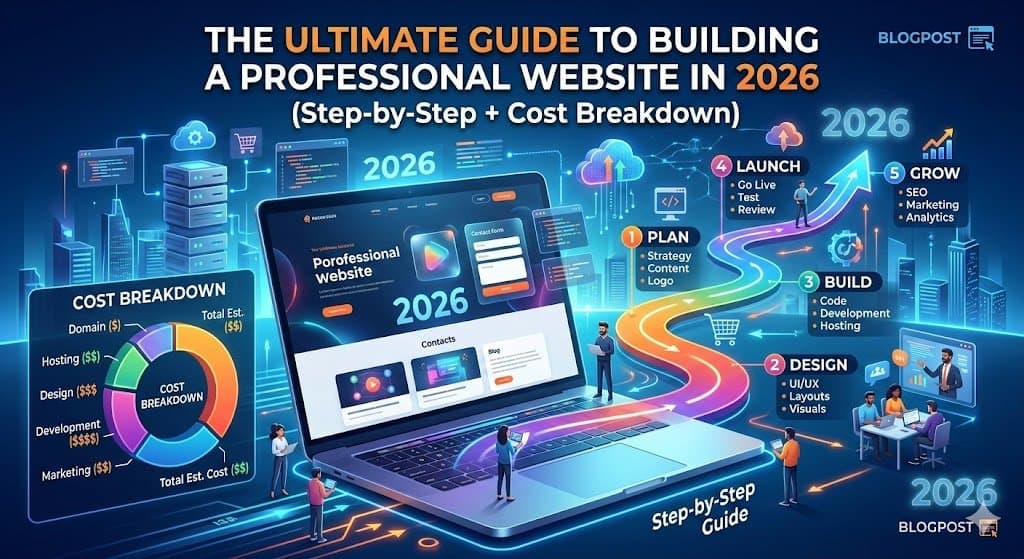
The Complete Guide to Building a Professional Website in 2026
(And Why Most Websites Don’t Generate Real Results)
Let me start with a statement that might be a bit too direct:
Most websites today simply don’t work.
Do they look good? Sometimes.
Are the colors nice? Maybe.
But do they bring customers? Rarely.
In 2026, having a website is no longer a competitive advantage.
The real advantage is how the website was built — and why it was built this way.
The difference between a website that exists… and a website that works…
is the difference between a cost and an investment.
If you’re thinking about building a website that actually supports a clear business goal, explore our Custom Website Development service to see how we plan and execute websites built for long-term growth.
The Truth No One Likes to Say
Many companies build a website because they feel “forced” to:
A competitor has one
A client asked for a link
Someone told them it’s necessary
So the project starts from the wrong angle.
Instead of asking:
How do we build a website that supports our business goals?
They ask:
How much will it cost?
And that’s where the problem begins.
When a website is treated as a “checkbox,” the result will be a checkbox website.
Why Do Most Websites Fail?
Let’s be realistic.
1️⃣ No Clear Goal
Many websites don’t know what they want the visitor to do.
Is the goal to:
Request a quote?
Book a consultation?
Buy a product?
Download a file?
If the goal isn’t clear, the visitor will leave without taking action.
The irony is that many business owners assume the problem is “low traffic,”
when the real issue is usually the lack of a clear conversion path.
2️⃣ Focusing on Looks More Than Function
One of the most common sentences you hear in meetings:
“We want the website to look modern.”
Yes — design matters.
But design without strategy doesn’t sell.
A professional website in 2026 isn’t measured by beauty alone,
but by its ability to:
Guide the visitor
Reduce distractions
Make decision-making easier
Build trust fast
Beauty is a component… but it’s not the system.
3️⃣ Ignoring User Experience
In many cases, websites are built from the business owner’s perspective — not the customer’s.
That’s a big difference.
The business owner wants to show everything.
The customer wants to understand quickly.
When a visitor lands on a crowded website full of text with no logical flow…
they don’t try to understand it.
They leave.
First impressions are formed in seconds — and in a competitive market, those seconds are everything.
A Website Isn’t a Brochure… It’s a System
A common mistake is treating a website as just a place to display information.
But a successful website is:
A marketing tool
A lead filtering tool
A persuasion tool
And sometimes a complete sales engine
If your website doesn’t help you:
Attract the right customer
Filter out the wrong customer
Improve the quality of inbound leads
Then it’s not doing its real job.
The Difference Between “A Website That Exists” and “A Website That Works”
Let’s break it down clearly.
A website that exists:
Shows general information
Has no clear call-to-action
Doesn’t measure performance
Isn’t improved after launch
A website that works:
Is built around a clear business goal
Has clear conversion journeys
Is measured and continuously improved
Scales as the business grows
The difference isn’t only budget…
it’s the way you think from day one.
In 2026… Competition Changed
The market no longer rewards “who has a website.”
It rewards:
Who explains better
Who convinces faster
Who builds trust faster
Who makes it easier to take the next step
And it all starts with a professional website built on strategy — not a template.
A Question You Should Ask Yourself Now
If a potential customer visits your website today,
will they understand within 30 seconds:
What you offer?
Who it’s for?
Why they should trust you?
What the next step is?
If the answer isn’t clear…
the problem isn’t ads.
not the market.
It’s your digital foundation.
Before We Talk About “How to Build a Website”
We need to first understand:
What type of website do you actually need?
Is a corporate website enough?
Do you need a full e-commerce system?
Or do you need an internal operations platform?
Mixing these types is one of the main reasons businesses rebuild later — at a much higher cost.
In the next section, we’ll break down the differences between a corporate website, an e-commerce store, and a custom-built platform — so you can choose what truly supports your goals.
What Type of Website Do You Actually Need?
(This Isn’t a Technical Problem — It’s a Strategic One)
A common mistake is starting execution before choosing the right type of website.
Many businesses start with:
“We need a website.”
But the better question is:
What type of website supports your business model?
Confusing these three types is one of the biggest reasons businesses rebuild after a year or two — sometimes at double the cost.
1️⃣ Corporate Website
This type is best for businesses that focus on:
Selling services
Receiving inquiries
Building credibility
Showcasing work and case studies
Its main role isn’t direct selling — it’s persuasion and trust.
Even a corporate website can fail if:
The audience isn’t well-defined
The message isn’t clear
There is no obvious, direct communication path
A successful corporate website is not “more information.”
It’s “organized information that leads to a decision.”
2️⃣ E-commerce Website
This is not just product listings.
It includes:
Payment gateways
Order management
Shipping
Inventory
Coupons
Reporting
An e-commerce website is not a product page…
it’s a full operating system.
If you’re planning to launch a serious online store, explore our E-commerce Solutions service to learn how we build scalable stores designed for growth.
The common mistake is treating it like design only,
when most of it is operational and technical.
If you’re selling online, it’s not about how it looks — it’s about how it’s built.
3️⃣ A Custom Website as a Business System
Here’s the level most companies ignore.
Some businesses don’t need a traditional website…
they need:
A management system
A dashboard
An operations platform
A user portal
In that case, “templates” don’t make sense.
Because the product here isn’t an interface — it’s an operating foundation.
Some projects require a fully custom internal platform — and that’s where our Web Applications & Systems Development service becomes the right solution, built around real workflows and business needs.
Why Choosing the Wrong Type Is Expensive
Because every technical decision made on incorrect assumptions leads to:
Rebuilding
Data migration
Time loss
And sometimes SEO ranking loss
The cost isn’t just financial…
it’s strategic.
What Makes a Website Actually Work?
After choosing the right type, the most important phase begins:
How do we make it work?
This is where we enter factors most proposals never mention.
1️⃣ Architecture Before Design
A website that starts with design before planning
is like building a house before drawing the blueprint.
Before choosing a color or a font, you must define:
The core pages
The visitor journey
Decision points
Likely objections
This is conversion architecture — not “pretty design.”
2️⃣ Thinking in Scalability
One of the most important questions people forget:
What happens if traffic doubles?
What if you add a new service?
What if you launch a major campaign?
If the foundation isn’t scalable, future growth becomes painful.
3️⃣ Performance Isn’t Optional
In 2026, speed is not just an optimization factor…
it’s a trust factor.
A slow website signals low professionalism.
The numbers are clear:
every extra second of loading reduces conversion probability.
That’s why performance optimization must be built into development — not added later.
4️⃣ Measuring Everything
One key difference between an average website and a professional one:
Do you measure performance?
Visitors
Traffic sources
Top-performing pages
Conversion rate
Without data, you operate on assumptions.
Website Cost: Expense or Investment?
People often ask:
“How much does a professional website cost?”
A better question is:
How much will it return?
If your website can:
Generate just one high-value client per month
Improve conversion rate slightly
Reduce dependency on paid ads
Then it’s not an expense…
it’s a digital asset.
Many compare prices without comparing results.
How to Choose a Development Partner Who Actually Understands
The market is full of similar offers.
The difference shows in the mindset.
A strong company doesn’t start with design…
it starts with questions:
What’s your real goal?
Who is your audience?
What’s your growth plan?
What do you want to avoid?
If the entire conversation is about colors and templates…
you’re dealing with execution — not strategic partnership.
After Launch… The Real Phase Begins
Launching the website is not the finish line.
It’s the starting point.
A professional website is:
Continuously improved
Content is refined
Elements are tested
Features evolve
Projects that treat the website as a living asset move forward.
Projects that leave it unchanged fall behind.
Some businesses that depend on internal operations and teams may also connect their website to advanced systems such as HR management platforms or custom SaaS solutions, depending on the nature of the business.
Conclusion
In 2026, the question is no longer:
“Do you have a website?”
It’s now:
“Does your website work?”
A professional website isn’t just a beautiful design.
It’s strategy, architecture, systems, and continuous analysis.
Built correctly, it becomes one of your most valuable business assets.
Built traditionally, it stays just another page on the internet.
The Next Step
If you’re thinking of creating a new website
or upgrading your current one,
start with the right question:
What is the real goal behind it?
At PlanKit.dev, we don’t build websites just to “exist.”
We build digital systems designed for long-term growth.
📞 Book a consultation to discuss your project
💬 Reach out to see if your current website needs improvement
📩 Start building a website that works — not just a website that exists
PlanKit.dev — Websites built on strategy, not templates.
Frequently Asked Questions (FAQ)
What does a professional website cost in 2026?
It depends on the project type, number of pages, and required features. The most important part is defining the business goal to ensure real ROI.
What’s the difference between a template website and a custom website?
Template websites are built on pre-made designs with limited flexibility. Custom websites are built around your goals and scale better long-term.
How long does it take to build a professional website?
It varies based on complexity — from a few weeks for simple websites to longer for advanced platforms that require planning, development, and testing.
Can I improve my existing website instead of rebuilding?
Sometimes yes — through restructuring, speed optimization, and UX improvements. But if the foundation is outdated, rebuilding may be the smarter long-term move.
Does website design affect search rankings?
Yes. Speed, user experience, and structure all influence SEO performance. Websites built with SEO standards from day one have stronger chances to rank.